GB300 DGX Station: What 748GB of Coherent Memory Actually Buys
The GB300 Grace Blackwell Ultra Desktop Superchip puts 748GB of coherent memory on a desk. Which workloads earn it back, and which ones don't.
By Rob Teller ·
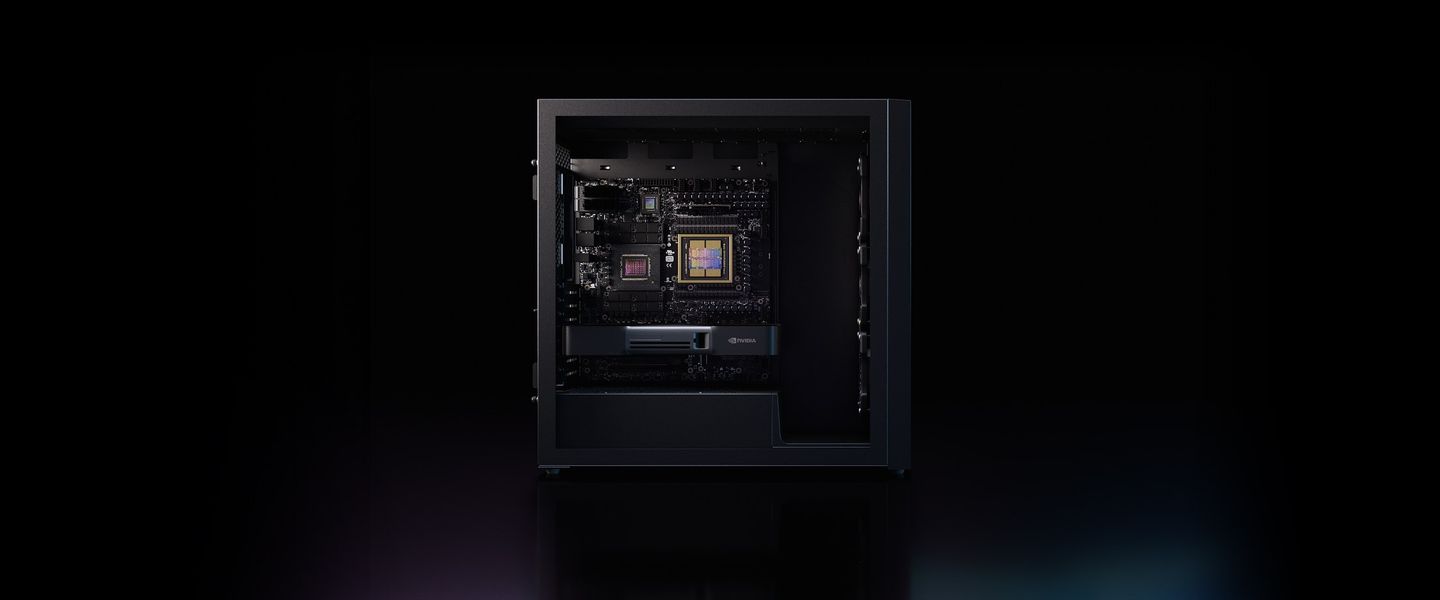
The NVIDIA GB300 Grace Blackwell Ultra Desktop Superchip puts 748GB of coherent memory under a desk. No rack, no cloud contract, one 1,600 W wall circuit. That memory number is the reason anyone buys one. We're quoting GB300 DGX Station configurations now.
NVIDIA showed the Station at GTC 2025 and it took most of a year to reach desks. Dell shipped first in March 2026, ASUS followed in June, and the OEM list has been filling in since. The machine is expensive and it has a narrow job. Worth knowing which workloads pay it back before the PO goes out.
What's actually in the GB300 Grace Blackwell Ultra Desktop Superchip
One package, two dies. A 72-core Grace CPU on Arm Neoverse V2 cores, a Blackwell Ultra GPU, and NVLink-C2C running 900 GB/s between them. Because both sides sit in one coherent memory domain, either processor addresses the whole 748GB without you writing a copy. No staging buffer, no host-to-device hop in the hot path.
The pool is split by type, not by owner. 252GB of HBM3e at 7.1 TB/s holds weights and activations. 496GB of LPDDR5X at 396 GB/s holds everything else.
Spec | GB300 DGX Station |
|---|---|
GPU | 1x NVIDIA Blackwell Ultra |
CPU | 1x Grace, 72-core Arm Neoverse V2 |
GPU memory | 252GB HBM3e, 7.1 TB/s |
CPU memory | 496GB LPDDR5X, 396 GB/s |
Total coherent memory | 748GB |
NVLink-C2C | 900 GB/s |
MIG instances | 7 |
Networking | ConnectX-8 SuperNIC, up to 800 Gb/s |
Ethernet ports | 2x QSFP112 400GbE, 1x RJ45 10GbE, 1x RJ45 1GbE for BMC |
PCIe slots | 1x Gen 5 x16, 2x Gen 5 x16 at x8 electrical |
Storage | 4x M.2 Gen 5 |
Video out | Mini DisplayPort, system management only |
Total system power | 1,600 W |
OS | Ubuntu with NVIDIA AI Developer Tools |
GPU
- GB300 DGX Station
1x NVIDIA Blackwell Ultra
CPU
- GB300 DGX Station
1x Grace, 72-core Arm Neoverse V2
GPU memory
- GB300 DGX Station
252GB HBM3e, 7.1 TB/s
CPU memory
- GB300 DGX Station
496GB LPDDR5X, 396 GB/s
Total coherent memory
- GB300 DGX Station
748GB
NVLink-C2C
- GB300 DGX Station
900 GB/s
MIG instances
- GB300 DGX Station
7
Networking
- GB300 DGX Station
ConnectX-8 SuperNIC, up to 800 Gb/s
Ethernet ports
- GB300 DGX Station
2x QSFP112 400GbE, 1x RJ45 10GbE, 1x RJ45 1GbE for BMC
PCIe slots
- GB300 DGX Station
1x Gen 5 x16, 2x Gen 5 x16 at x8 electrical
Storage
- GB300 DGX Station
4x M.2 Gen 5
Video out
- GB300 DGX Station
Mini DisplayPort, system management only
Total system power
- GB300 DGX Station
1,600 W
OS
- GB300 DGX Station
Ubuntu with NVIDIA AI Developer Tools

Two corrections worth making, because the spec gets repeated wrong. Those are not three full x16 slots. One is x16 electrical and two are x16-length wired at x8. And NVIDIA supports up to one additional RTX PRO Blackwell GPU alongside the Superchip, not a slot full of them.
The precision ladder, and the one number nobody prints
GB300 is a 4-bit machine that can do other things. NVFP4 is where the silicon lives, and the ladder falls off exactly as you'd expect until you get to the bottom, where it falls off a cliff.
Precision | Throughput |
|---|---|
FP4 Tensor Core | 20 PFLOPS |
FP8 / FP6 Tensor Core | 10 PFLOPS |
FP16 / BF16 Tensor Core | 5 PFLOPS |
TF32 Tensor Core | 2.5 PFLOPS |
INT8 Tensor Core | 330 TOPS |
FP32 | 80 TFLOPS |
FP64 and FP64 Tensor Core | 1.3 TFLOPS |
FP4 Tensor Core
- Throughput
20 PFLOPS
FP8 / FP6 Tensor Core
- Throughput
10 PFLOPS
FP16 / BF16 Tensor Core
- Throughput
5 PFLOPS
TF32 Tensor Core
- Throughput
2.5 PFLOPS
INT8 Tensor Core
- Throughput
330 TOPS
FP32
- Throughput
80 TFLOPS
FP64 and FP64 Tensor Core
- Throughput
1.3 TFLOPS
FP64 at 1.3 TFLOPS is the line to read twice if you were thinking about classical HPC. A GB300 is not a double-precision machine and was never trying to be. Computational chemistry, CFD, FEA and anything else that lives in FP64 should not go anywhere near this box. NVIDIA publishes the figure plainly. Nobody quotes it.
How much model fits in 748GB of coherent memory
The ability to stop quantizing, mostly.
An RTX 5090 gives you 32GB of VRAM. Four RTX PRO 6000 Blackwell cards get you 384GB. That second number is where the comparison usually goes wrong. 384GB is four separate 96GB pools, your framework has to shard a model across them, and every shard boundary costs you something. The GB300's 748GB is one address space. Different problem.
Llama 3.1 405B in full BF16 wants roughly 810GB. With the coherent pool and some optimization, that class of model is on the table, and NVIDIA rates the platform to a trillion parameters at FP4. Serving is unremarkable in the good way: point vLLM at it, expose an OpenAI-compatible endpoint on your own network, and the tooling your team already wrote keeps working.

Mixture-of-experts models suit this box especially well. MoE trades a large resident parameter count for a small active one, and resident parameter count is precisely what 748GB is for.
GB300 vs GB200, DGX Spark, and a quad RTX PRO 6000 workstation
There is no GB200 desktop part, so “GB300 vs GB200” in practice means desk versus rack. If you want GB200-class capacity you are buying rack infrastructure.
Option | Memory a model can see | Honest fit |
|---|---|---|
RTX 5090 workstation | 32GB VRAM | Single-GPU dev, 7B to 13B |
DGX Spark, GB10 | 128GB unified | One developer, prototyping, learning the stack |
Quad RTX PRO 6000 Blackwell | 384GB across 4 separate pools | Strong all-rounder, real display output, sharding required |
DGX Station, GB300 | 748GB coherent | Frontier-scale models on one private node |
GB300 NVL72 | Rack scale, 72 Blackwell Ultra GPUs | Production serving at enterprise scale |
RTX 5090 workstation
- Memory a model can see
32GB VRAM
- Honest fit
Single-GPU dev, 7B to 13B
DGX Spark, GB10
- Memory a model can see
128GB unified
- Honest fit
One developer, prototyping, learning the stack
Quad RTX PRO 6000 Blackwell
- Memory a model can see
384GB across 4 separate pools
- Honest fit
Strong all-rounder, real display output, sharding required
DGX Station, GB300
- Memory a model can see
748GB coherent
- Honest fit
Frontier-scale models on one private node
GB300 NVL72
- Memory a model can see
Rack scale, 72 Blackwell Ultra GPUs
- Honest fit
Production serving at enterprise scale
GB300 NVL72 vs DGX Station is the easy call of the group. The NVL72 is a rack, with rack power, rack cooling, rack lead time and a services engagement attached. The Station plugs into a wall. It's what you deploy while the rack quote is still in legal, or instead of a rack that was always more than you needed.
If your models fit on one card, buy one card. That advice costs us a sale and it's still the right advice.
GB300 MIG partitions: one chip, seven tenants
Multi-Instance GPU splits the Blackwell Ultra into as many as seven isolated instances, each with its own HBM3e slice, cache and compute cores. A production inference instance, two eval jobs and somebody's notebook can share the machine without fighting over memory bandwidth, with guaranteed quality of service on each partition.
This is also the answer to “we can't justify a $100k box for one person.” Seven tenants changes the arithmetic.
GB300 fine-tuning: LoRA, QLoRA, and when you need full parameter
Fine-tuning on a GB300 looks like fine-tuning on a small server, because that's what it is.
- LoRA and QLoRA adapters for internal terminology, ticket histories, product docs and support transcripts. The headroom means QLoRA becomes a choice instead of a requirement.
- Full-parameter fine-tuning on small and mid-size models, where accuracy beats turnaround and the training data isn't allowed to travel.
- Embedding and reranker training for RAG retrieval quality. Usually a bigger win than touching the base model, and almost nobody budgets GPU time for it.
The real gain is iteration speed. Engineers run experiments when they think of them rather than when cloud capacity frees up, and nobody watches a GPU-hour meter while a run finishes.
Why GB300 keeps showing up in federal procurement
Interest in GB300-class systems has picked up noticeably in federal channels, SAM.gov included, and it isn't about petaFLOPS. It's about where the data is allowed to sit.
A GB300 DGX Station runs happily as a headless compute node on a closed network. The Mini DisplayPort is BMC-only, for system management. That's the right shape for this buyer. The machine goes in a secure room, gets reached over the network, and never needs a monitor. CUI and anything carrying a sovereignty requirement stays inside the boundary. There's no cloud egress to account for because there's no cloud.
The manageability story matters more here than it does commercially. Out-of-band telemetry through the BMC, Redfish API support, NVIDIA DCGM for fleet monitoring, hardware root of trust and enterprise secure boot. That's an accreditation package, not a feature list.
Then the procurement math. Metered cloud spend is an operating cost that gets re-justified every cycle and can move without notice. A GB300 is a capital line item with a known number. Air-gapped deployment removes an entire category of accreditation work, and data sovereignty stops being an architecture diagram and becomes a serial number in a room.
Two details for this buyer specifically. MIG lets one node serve several programs with hard isolation between them, which is easier to defend than four half-used machines. And the ConnectX-8 SuperNIC's dual 400GbE QSFP112 ports pair two Stations directly on a closed fabric, no switch, no shared infrastructure.
GB300 vs cloud GPU hours
On-demand H100 instances run roughly $10 to $12 per GPU-hour. Sustained inference or a regular fine-tuning cadence lands here:
Path | Monthly | 12 months |
|---|---|---|
Cloud GPU, modest sustained use | $8,000 to $10,000 | $96,000 to $120,000 |
Cloud GPU, heavy use | $15,000 to $20,000 | $180,000 to $240,000 |
GB300 DGX Station | Capital cost, plus power and ops | Fixed and known |
Cloud GPU, modest sustained use
- Monthly
$8,000 to $10,000
- 12 months
$96,000 to $120,000
Cloud GPU, heavy use
- Monthly
$15,000 to $20,000
- 12 months
$180,000 to $240,000
GB300 DGX Station
- Monthly
Capital cost, plus power and ops
- 12 months
Fixed and known
At the heavy end the hardware clears inside a year, which is why cloud repatriation is the most common reason anyone calls us about these. The softer argument is availability. Cloud GPU capacity isn't guaranteed and pricing moves. Owning the node means the compute is there on a Sunday night.
Where the GB300 falls short
The honest list, so nobody finds out after delivery.
- No usable video output. The Superchip is compute-only and the Mini DisplayPort is for management. Want a display, add one RTX PRO card: RTX PRO 2000 Blackwell, RTX PRO 4000 Blackwell SFF, RTX PRO 6000 Workstation Edition or RTX PRO 6000 Blackwell Max-Q.
- FP64 is 1.3 TFLOPS. Traditional simulation and solver work belongs on Xeon or EPYC with a different accelerator.
- Grace is the wrong CPU for CPU-bound jobs. 72 Neoverse V2 cores are excellent at feeding a GPU and unremarkable at rendering, meshing and single-thread licensed CAE. Buying a GB300 to run those is a mistake with a long invoice.
- 1,600 W. Check the circuit before the crate shows up. Supermicro's version is liquid-cooled for a reason.
- Allocation. GB300 supply is allocated. Plan in weeks.
GB300 DGX Station SKUs, vendor by vendor
Same NVIDIA platform underneath, different chassis, cooling, support terms and part numbers. Exxact's Valence VWS-158270643 is the SKU most people have seen, since it's the one quoted in most of the coverage.
Vendor | Product | Part number |
|---|---|---|
Exxact | Valence DGX Station | VWS-158270643 |
Exxact | Valence DGX Station | VWS-117032084 |
Exxact | TensorEX DGX Station | TWS-188490844 |
ASUS | ExpertCenter Pro ET900N G3 | ET900N G3 |
Dell | Pro Max with GB300 | FCT6263 |
Supermicro | Super AI Station, liquid-cooled | ARS-511GD-NB-LCC |
MSI | XpertStation WS300 | WS300T60L |
GIGABYTE | W775 Deskside AI Supercomputer | W775-V10-L01 |
HP | ZGX Fury AI Station | |
BIZON | AI Station GB300 | |
GPU Partner | ||
GPU Partner | WS300T60L |
Exxact
- Product
Valence DGX Station
- Part number
VWS-158270643
Exxact
- Product
Valence DGX Station
- Part number
VWS-117032084
Exxact
- Product
TensorEX DGX Station
- Part number
TWS-188490844
ASUS
- Product
ExpertCenter Pro ET900N G3
- Part number
ET900N G3
Dell
- Product
Pro Max with GB300
- Part number
FCT6263
Supermicro
- Product
Super AI Station, liquid-cooled
- Part number
ARS-511GD-NB-LCC
MSI
- Product
XpertStation WS300
- Part number
WS300T60L
GIGABYTE
- Product
W775 Deskside AI Supercomputer
- Part number
W775-V10-L01
HP
- Product
ZGX Fury AI Station
- Part number
BIZON
- Product
AI Station GB300
- Part number
GPU Partner
- Product
- Part number
GPU Partner
- Product
- Part number
WS300T60L
Two traps in that table. HP's G1n suffix belongs to the ZGX Nano, the GB10 machine, not the GB300 Fury, and it gets misattributed constantly. And ASUS's own part number is plain ET900N G3. The G3-2SSD and G3-4SSD-V2 strings you'll see in the channel are reseller storage configurations, not ASUS designations. MSI's WS300T60L sits on the CT60-S8060 baseboard, so both numbers are correct depending on whether you're buying the system or the barebone.
Lenovo, Lambda and BOXX were named in the original March 2025 announcement and are not on NVIDIA's current partner strip. Treat them as unconfirmed for GB300 until they publish a part number.
Not ready for a Station? The DGX Spark is the same software stack at 128GB, and it's the right first box for one developer.
“I've watched a lot of hardware get sold on a number nobody uses. 748GB isn't one of them. My money's on two buyers getting these first: the team that already knows its monthly cloud invoice to the dollar, and the agency that can't put the data in a cloud at all. Everybody else should buy four RTX PRO 6000s and keep the change.”
Availability
We quote the GB300 DGX Station in headless form for closed-network and air-gapped deployment, and with a single RTX PRO card when somebody needs a display. Price and lead time move with allocation, so both come from the quote rather than a list. Configurations and full specs on the product page.
sales@gpupartner.com • +1.626.88G.PU00
Sources
Source | URL |
|---|---|
NVIDIA DGX Station product page and specifications | |
NVIDIA DGX Station for Windows | nvidia.com/en-us/products/workstations/dgx-station-for-windows |
NVIDIA Multi-Instance GPU user guide | |
ASUS ExpertCenter Pro ET900N G3 | asus.com/us/displays-desktops/workstations/performance/expertcenter-pro-et900n-g3 |
Dell Pro Max with GB300, FCT6263 | dell.com/en-us/shop/desktop-computers/dell-pro-max-with-gb300 |
HP ZGX Fury AI Station | |
Supermicro Super AI Station, ARS-511GD-NB-LCC | |
GIGABYTE W775-V10-L01 | |
MSI XpertStation WS300 |
NVIDIA DGX Station product page and specifications
NVIDIA DGX Station for Windows
NVIDIA Multi-Instance GPU user guide
ASUS ExpertCenter Pro ET900N G3
Dell Pro Max with GB300, FCT6263
HP ZGX Fury AI Station
Supermicro Super AI Station, ARS-511GD-NB-LCC
GIGABYTE W775-V10-L01
MSI XpertStation WS300
- GB300
- GB300 Grace Blackwell Ultra Desktop Superchip
- DGX Station GB300
- GB300 748GB coherent memory
- GB300 unified memory
- GB300 vs GB200
- GB300 vs RTX PRO 6000
- GB300 vs DGX Spark
- GB300 NVL72 vs DGX Station
- GB300 MIG partitions
- GB300 Multi-Instance GPU
- GB300 no video output
- GB300 Mini DisplayPort BMC
- GB300 headless compute node
- GB300 air-gapped deployment
- GB300 data sovereignty
- GB300 CUI on-prem
- GB300 federal procurement
- GB300 SAM.gov
- GB300 cloud repatriation
- GB300 TCO
- DGX Station GB300 price
- GB300 lead time
- GB300 power draw 1600W
- GB300 FP64 1.3 TFLOPS
- GB300 LLM inference
- GB300 fine-tuning
- GB300 LoRA QLoRA
- GB300 vLLM
- GB300 mixture-of-experts
- NVLink-C2C 900 GB/s
- HBM3e 7.1 TB/s
- LPDDR5X 396 GB/s
- NVFP4
- BF16
- Arm Neoverse V2
- ConnectX-8 SuperNIC
- QSFP112 400GbE
- PCIe Gen 5 x16 x8 electrical
- Redfish API BMC
- NVIDIA DCGM
- hardware root of trust secure boot
- DGX Station for Windows
- Exxact VWS-158270643
- Exxact TWS-188490844
- Exxact VWS-117032084
- ASUS ExpertCenter Pro ET900N G3
- MSI XpertStation WS300 WS300T60L
- MSI CT60-S8060
- Dell Pro Max FCT6263
- HP ZGX Fury AI Station
- Supermicro Super AI Station ARS-511GD-NB-LCC
- GIGABYTE W775-V10-L01
- BIZON AI Station GB300